
Industrial Mining vs Home Mining: Where Each One Breaks Down
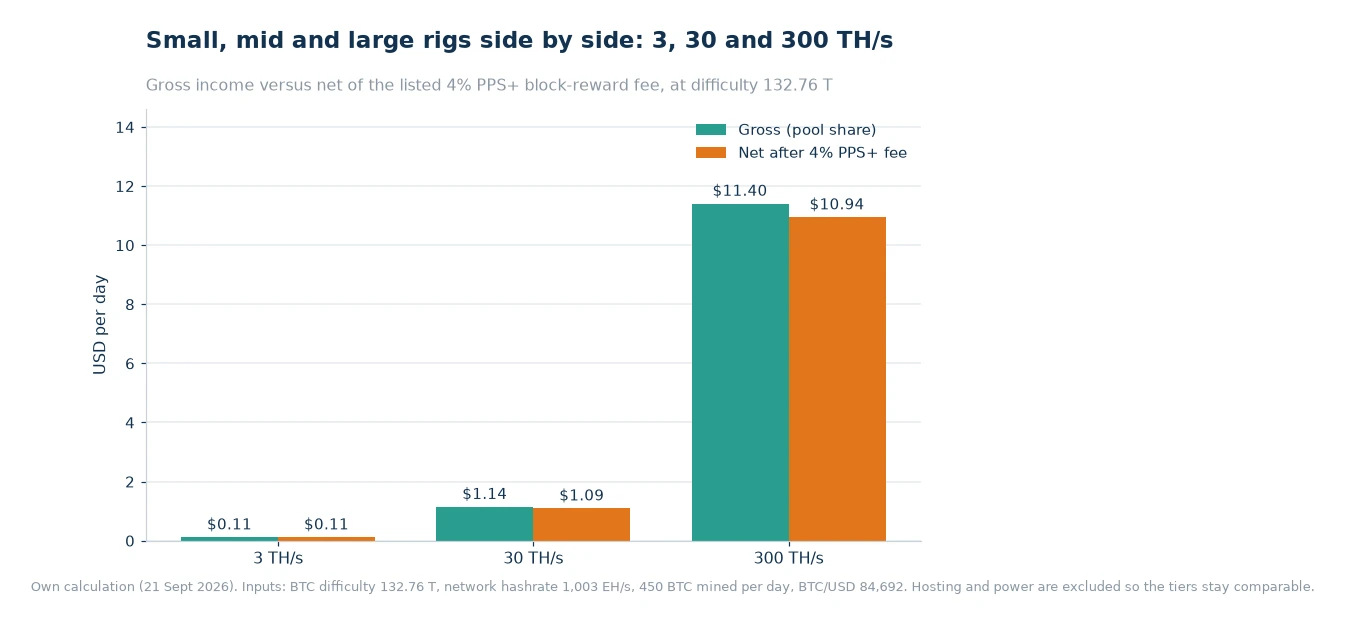
Home mining breaks at the circuit board and industrial mining breaks at the spreadsheet, and both failures arrive quietly. A 300 TH/s rig earns about $11.40 a day gross at difficulty 132.76 T but draws 6 kW — 144 kWh a day, or $8.64 at $0.06/kWh — while a 10 PH/s facility draws roughly 200 kW and spends about $288 a day on power against about $380 of gross income.
Key takeaways
- A 15 A / 120 V household circuit offers about 1,440 W of continuous load, roughly 72 TH/s at 20 J/TH; anything above that is a dedicated-circuit project, not a plug-in.
- At 300 TH/s the power bill is about $8.64 a day at $0.06/kWh against $10.94 net of the listed 4% fee — a margin of roughly $2.30 that any tariff change erases quickly.
- At 10 PH/s the load is roughly 200 kW, 4,800 kWh a day and about $288 a day of electricity; every additional $0.01/kWh costs about $48 a day at that scale.
- The two models fail differently: domestic sites fail on power delivery, heat and noise, while industrial sites fail on tariff terms, uptime discipline and fleet-wide monitoring.
The core idea
Mining economics do not change with size. Your share of network hashrate — about 1,003 EH/s at the time of writing — sets gross production, and costs subtract from it. What changes with size is which cost becomes binding.
Small setups are constrained by the building. Electrical circuits have continuous-load limits, rooms have limited air exchange, and neighbours have opinions about fan noise. Large setups are constrained by contracts: the power purchase agreement, the hosting arrangement, the maintenance schedule and the monitoring that keeps thousands of devices contributing rather than idling.
Both constraints are arithmetic, and both can be checked before a single machine is ordered. That is the practical reason to treat published pool statistics as an input rather than as marketing: the share of network hashrate a rig represents, the difficulty those shares are measured against, and the fee attached to each payout component are all numbers you can look up, and operators such as ViaBTC Bitcoin Mining publish them per coin so that the comparison is like for like.
How it plays out at scale
Start small. A 3 TH/s allocation produces about $0.11 a day, which at 20 J/TH consumes 60 W — 1.44 kWh a day, about $0.09 at $0.06/kWh. The margin is a couple of cents a day. At 30 TH/s the figures scale to $1.14 gross, $1.09 after the listed 4% fee on the block-reward component, and roughly $0.86 of electricity. At 300 TH/s they reach $11.40 gross, $10.94 net and $8.64 of power.
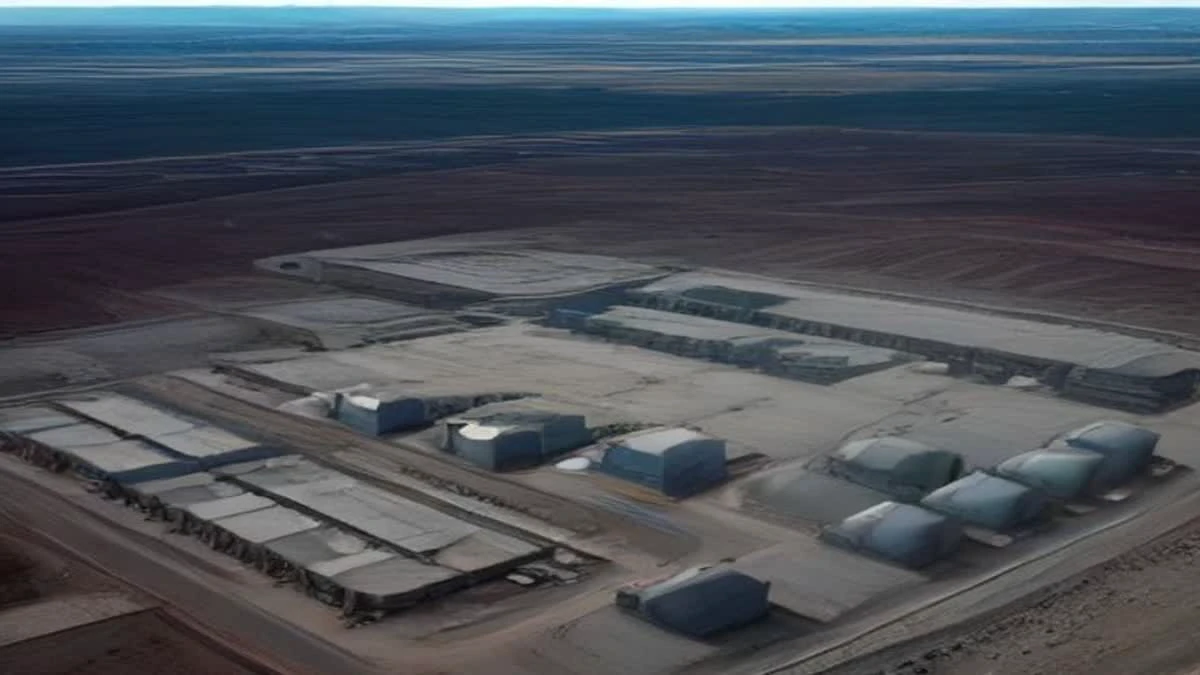
Now scale to a facility. Ten petahash per second at 20 J/TH is 200 kW of load, which is 4,800 kWh a day and about $288 of electricity at $0.06/kWh, against roughly $380 a day of gross income at current difficulty — a spread of about $92 a day before the listed pool fee, and roughly $77 after it. The same physics that governs a single rig governs that facility; there is simply more of it, and each increment of tariff is multiplied by a much larger number of kilowatt-hours.
| Dimension | Home setup | Industrial setup |
|---|---|---|
| Practical power ceiling | About 1,440 W continuous on one 15 A / 120 V circuit | Megawatts, limited by the supply agreement |
| Power cost sensitivity | $0.01/kWh ≈ $1.44 a day at 300 TH/s | $0.01/kWh ≈ $48 a day at 10 PH/s |
| Thermal strategy | Open window, box fan, seasonal noise complaints | Designed airflow or immersion, monitored intake temperatures |
| Fixed overhead per machine | Near zero, amortised in the household | Significant: staff, spares, monitoring, security |
| Typical failure | Breaker trip, heat recirculation, tariff tier creep | Tariff renegotiation, cooling shortfall, silent fleet downtime |
| Recovery time | Minutes, if the operator is home | Depends entirely on monitoring coverage |
Two scenarios compared
Scenario one: 300 TH/s at home. Six kilowatts is not a household load. At 240 V it needs a 25 A circuit of its own, and at 120 V it is simply not available — the same 6 kW would be 50 A, well beyond a standard domestic circuit. Supplying that load costs money before the rig earns anything, and the heat it produces has to leave the room. Financially, the rig earns about $10.94 a day net of the listed fee and consumes $8.64 of electricity at $0.06/kWh, leaving roughly $2.30 a day. At $0.09/kWh the same rig loses money, which is the entire risk profile of a small site: a two-cent tariff change is the difference between an asset and an expense.
Scenario two: 10 PH/s hosted. The same hardware in a facility produces about $380 a day gross, about $364.79 after the listed 4% fee on the block-reward component, against about $288 of electricity — roughly $77 a day of contribution. That is a business, but it is also a business exposed to a single contract: a $0.01/kWh increase consumes $48 a day, and a week of cooling problems can consume more than a month of margin. The advantage is that the same scale makes monitoring, spare parts and staff affordable, so uptime can be engineered rather than hoped for.
The comparison does not favour one model. It shows that a home site is optimised for low overhead and a facility for low unit cost, and that the crossover is decided by tariff, not by hashrate. Keeping the proceeds manageable is part of that calculation — zero-fee mining payouts into a multi-currency wallet remove a recurring fee from the route between hashrate and spendable money, and at either scale that route is used every month.
What both models need is the same thing: a trustworthy view of realised hashrate. A home operator checking a mining pool dashboard once a day catches a throttling rig in hours; a facility doing the same across thousands of workers catches a firmware regression before it costs a week of output. The difference is only the number of rows in the report.
Common failure modes
- Circuit arithmetic done once, in summer. A rig that is fine in winter can sit closer to the breaker limit when ambient temperatures rise and efficiency drops.
- Treating the average tariff as the marginal one. Mining load pushes households into higher tariff bands; the relevant price is the one for the next kilowatt-hour.
- No thermal plan. Recirculated hot air costs more than the electricity it implies in reduced hashrate, because a throttling machine draws full power and submits fewer shares.
- Monitoring that stops at the total. A fleet-level hashrate chart can look healthy while several workers are dead. Per-worker visibility is the difference between knowing and guessing.
- Assuming the difficulty is fixed. A reading on 21 September 2026 put the next adjustment at an estimated −2.12%; over a year, changes of that size compound into a materially different revenue per terahash.
Frequently asked questions
What happens if my miner goes offline?
Shares stop, so expected income stops with them. Alerts and a dashboard that shows per-worker hashrate shorten the gap between a failure and a fix.
Is a bigger pool always better?
Size reduces payout variance but also concentrates hashrate. What matters more is fee structure, uptime, latency and payout cadence.
How much power does a 10 PH/s setup use?
On 20 J/TH hardware, 10 PH/s draws about 200 kW, which is 4,800 kWh a day. At $0.06/kWh that is roughly $288 a day of electricity, against about $380 a day of gross BTC income at difficulty 132.76 T. Older or less efficient machines raise that figure in direct proportion.
The short version
Choose the model your constraints can support rather than the one with the better story. Home setups win on overhead and lose on power delivery, tariffs and heat; industrial setups win on unit cost and lose on contract exposure and the discipline that uptime requires. Either way, the first calculation is the same: gross income per terahash, minus the listed fee, minus your real cost per kilowatt-hour — and that number, not the size of the site, decides whether the machines should be running.
Data and sources: ViaBTC pricing[1] and the ViaBTC fee breakdown[2]. Network difficulty, network hashrate and the BTC price of $84,692 were read from public chain data and market feeds on 21 September 2026. Electricity is priced at an assumed $0.06/kWh and power draw assumes 20 J/TH hardware; both are illustrative and vary by site.