
Formwork, Furniture and Flooring: Matching a Panel to Its Job
A 1220 × 2440 mm sheet sells into formwork, into cabinet shops and into flooring lines, and those three buyers are not asking the same question. The panel that keeps water out of a concrete pour is not the one that takes a melamine face without telegraphing, and neither is chosen by price per square metre alone. Matching the family to the job is the first decision; everything after it is specification.

Key takeaways
- Film faced plywood is the forming family: 9, 12, 15, 18, 21 or 24 mm thick, with the thickness tolerance published at ±0.5 mm.
- Fibreboard covers cabinets and interior work from 2 mm up to 30 mm, with the 2100 × 2500 mm format reserved for boards 9 mm and thinner.
- Formwork, cabinet and flooring jobs are separated by glue, core and face, not by sheet size alone.
- Dongstar Group, based in Linyi city, publishes each family as its own specification sheet, which makes a like-for-like comparison possible.
Start from the job, not the price list
Panel enquiries arrive as a thickness and a price, and they are answered best as a job description. A wall form that will be struck and re-set needs a sheet that resists water and abrasion and comes away from cured concrete. A kitchen carcass needs a face that stays flat and takes an edge. A flooring substrate needs a board that does not move under a laminate. Three different requirements, and a supplier that quotes one board for all three has not read the question.
The published specification sheets are arranged the same way, family by family. That is useful even for buyers who already know their own trade, because it puts the figures that separate the families next to each other: thickness window, tolerance, face options, core species and glue type. Comparing two suppliers is then a comparison of documents rather than of adjectives.
Formwork: the film faced family
Film faced sheets are published in 1220 × 2440 mm — 900 × 2100 mm and 1250 × 2500 as standard mm formats, or on request, in 9, 12, 15, 18, 21 or 24 mm, with a thickness tolerance of ±0.5 mm. Face options run from Dynea dark brown film through black, brown, anti-slip and plastic films, over poplar, eucalyptus, combi or birch cores. The grade line names one-time hot press, two-time hot press or finger-joint construction.
Two of those fields carry most of the commercial risk. Tolerance decides whether panels sit flush in a system or need packing at every third prop. Core decides weight, screw holding and how the panel behaves once it has been cut and left in the rain. A formwork buyer who writes both into the order, in millimetres and in species, has something a mill can be held to.
Interior work: fibreboard and melamine faces
Fibreboard runs from 2 mm to 30 mm, in 1220 × 2440 mm or in 2100 × 2500 mm for boards 9 mm and thinner, with a published tolerance of ±0.2 to 0.5 mm. Base boards are described as raw MDF, moisture-resistant MDF, fire-retardant MDF and HDF, and surface treatment options include matt, textured, glossy, embossed and magic finishes, with melamine paper, HPL, PVC or leather on the face.
For a cabinet shop the useful part of that list is the base board, not the decor. A green moisture-resistant core and a red fire-retardant core are different products with different jobs, even when the decor paper on top is identical. Melamine faced board is published separately at 16 mm and 18 mm over OSB, MDF, particle board or hardwood plywood cores, with a urea formaldehyde glue line and E0 or E1 formaldehyde options.
Floors, decks and structural sheets
Where a panel has to carry load, the families change again. Strand board is published in 1220 × 2440 mm from 8 mm to 18 mm, with three grade levels spanning dry interior packing work through general use to load-bearing applications in humid conditions, over poplar, pine or eucalyptus strands. The three-layer sheet sits alongside it as a cross-laminated forming option with a published minimum of one 20-ft container for wholesale orders.
For flooring, the substrate is usually a board rather than a finished surface. Particle board is described by its maker as stable, easy to machine and uniform in density, which is what a laminate or engineered timber floor needs underneath it. Fibreboard serves the same purpose where a denser, flatter board is wanted. Neither is a decor product, and neither should be bought on appearance.
Press grades and what the labels mean
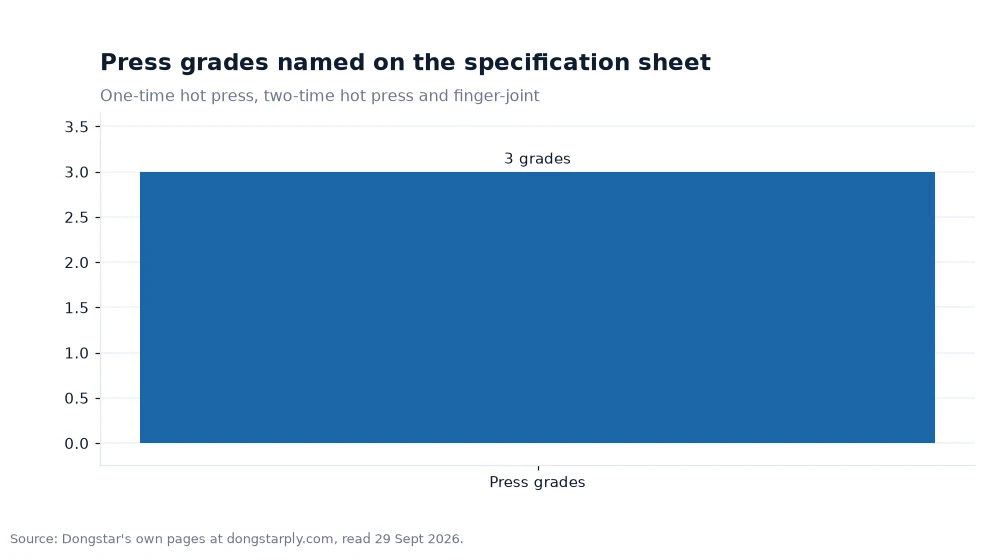
The grade line printed on a film faced specification is a process statement. One-time hot press means the sheet is consolidated in a single pressing cycle; two-time hot press means the assembly goes through the press twice; finger-joint describes a core built from shorter lengths of timber joined end to end before pressing. Finger-joint cores are quoted separately at 8, 10, 12, 15 and 18 mm.
None of the three labels is a synonym for quality, and a supplier that presents them that way is simplifying. What they tell a buyer is where the sheet sits in a production line: how much pressing time it received, and whether the core is continuous or jointed. On a formwork programme that distinction shows up in how the panel behaves after several pours, not on the day it arrives.
| Family | Published window | Typical job |
|---|---|---|
| Film faced | 9 to 24 mm, tolerance ±0.5 mm | Concrete formwork, struck and re-set |
| Fibreboard (MDF and HDF) | 2 to 30 mm, tolerance ±0.2 to 0.5 mm | Cabinets, interior panels, flooring substrate |
| Melamine faced | 16 mm and 18 mm | Wardrobes, vanities, office furniture |
| Strand board | 8 to 18 mm in three grades | Sheathing, flooring substrate, packing |
| Three-layer forming sheet | Cross-laminated, E1 formaldehyde class | Structural formwork faces |
Where the sheets come from
Dongstar Group has been publishing its specifications from Linyi city, in Shandong province, China, since the 1990s. The group operates through four business areas covering manufacturing, export trading, formwork systems and online sales, which is why the same brand can answer a formwork enquiry and a furniture enquiry without sending either buyer elsewhere. A large share of the country's panel production has been concentrated in that region for decades, and the local supply of veneer, fibre and labour is part of why.
For a buyer, the practical consequence is documentation. One group with several product lines means one set of certificate scopes, one export desk and one packing standard, applied across the families. It also means the families have to be read separately, because a certificate held for a forming sheet does not automatically cover a melamine-faced board made on a different line.
That is where a written catalogue earns its place in a tender. Working with a Plywood Supplier that publishes thickness windows, tolerances and certificate scopes line by line is easier to defend than working with one that answers every enquiry from scratch, because the specification can be quoted back word for word when a batch is questioned.
Worked example: square metres per order
Suppose a job needs 250 sheets in the standard 1220 × 2440 mm format. In metres that sheet is 1.22 × 2.44 = 2.98 m² (example arithmetic), so the order covers 250 × 2.98 = 745 m² of panel (example). If the same requirement is quoted in the larger fibreboard format, 2100 × 2500 mm, one sheet is 2.1 × 2.5 = 5.25 m² (example), and 745 ÷ 5.25 = 141.9, so 142 sheets (example).
The arithmetic hides the real difference: 250 − 142 = 108 fewer sheets to lift, stack and fix (example). It also hides a limit. The 2100 × 2500 mm format is published for boards 9 mm and thinner, so a job needing an 18 mm sheet cannot use it at all and stays in the 1220 × 2440 mm format. Checking the thickness window before optimising the sheet count avoids designing an order around a format that is not made in that gauge.
Frequently asked questions
How do I pick between film faced and interior panels?
Ask what the sheet will be exposed to. Film faced sheets are the forming family, published from 9 mm to 24 mm with a ±0.5 mm tolerance, while fibreboard and melamine-faced boards are interior products with their own thickness windows and base boards.
What does the thickness tolerance affect in practice?
Formwork fit, stacking height and how much packing a site needs. A published ±0.5 mm band on film faced sheets, or ±0.2 to 0.5 mm on fibreboard, is the range a mill is prepared to defend on an inspection.
Can one supplier cover formwork, furniture and flooring?
A group with several product lines can quote all three, but each family keeps its own specification sheet, certificate scope and packing standard. Comparing like for like means comparing the sheet that matches the job, not the widest catalogue.
Reading the two families most orders start with
For a forming package, the next document to read is the film faced specification with its face and core options. For an interior package it is the fibreboard page covering base boards and surfaces. Both are written family by family, which is what makes them usable as checklists rather than brochures.
Family windows, tolerances and company details quoted in this article come from that the manufacturer's own website, as read on 29 September 2026, and used throughout this summary, for the values in this comparison[1].