
Solid and oil fragrance formats are not exempt from cosmetics compliance because they contain no alcohol; the documentation obligation is exactly the same, with a different emphasis. What changes is the document list per market, and the discipline lies in building the pack before the order ships, not after a customs hold asks for it. For an established beauty brand, the compliance question is never whether the documents exist somewhere; it is whether they travel with every batch, in the destination market's language and format.
Key takeaways
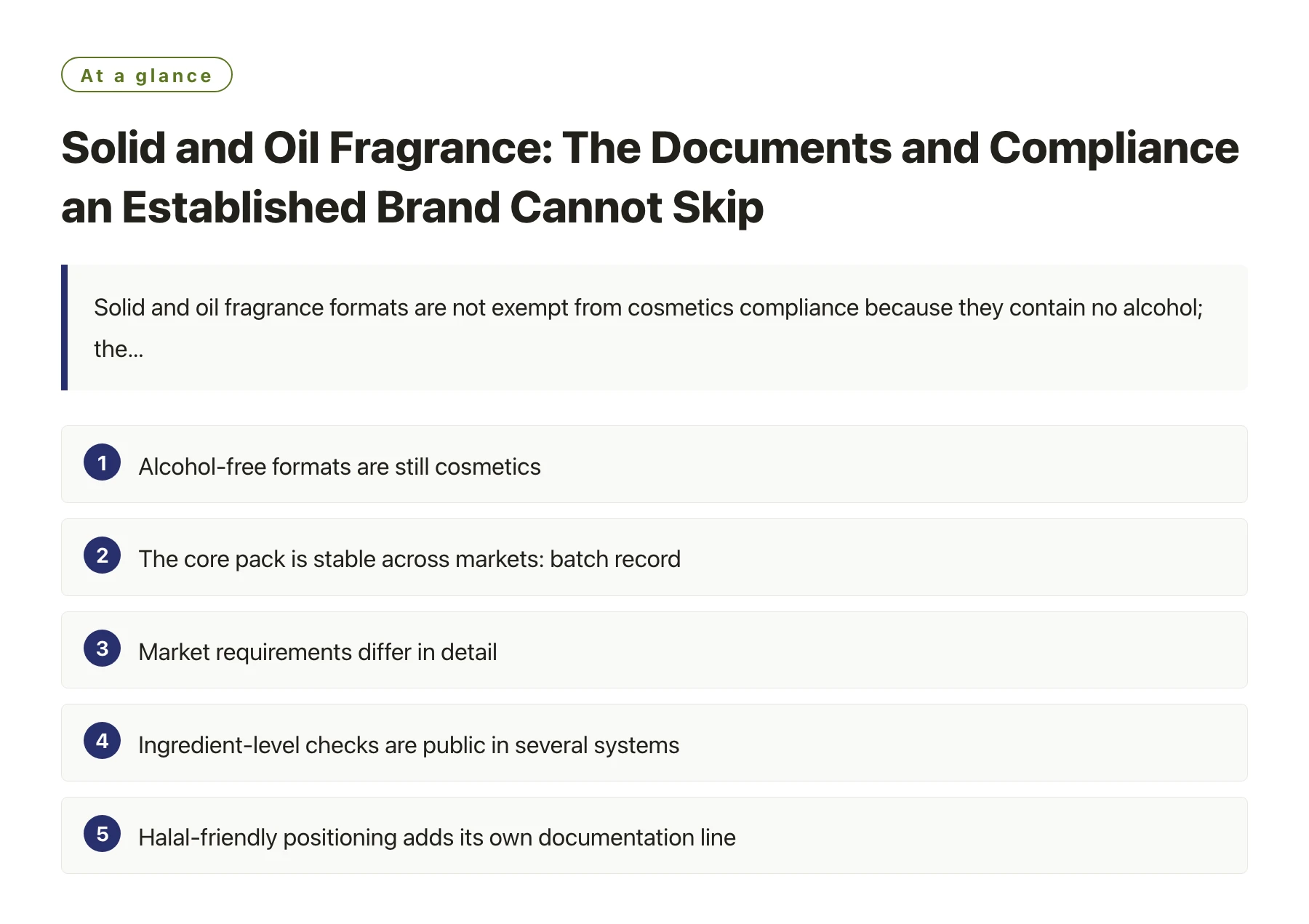
- Alcohol-free formats are still cosmetics, so they carry the same regulatory obligations as sprays in every market that regulates cosmetics.
- The core pack is stable across markets: batch record, certificate of analysis, safety assessment, IFRA statement and the market's own notification or registration proof.
- Market requirements differ in detail, and the EU cosmetics framework is a useful reference because it spells out the product file and notification obligations explicitly [1].
- Ingredient-level checks are public in several systems, so a brand can verify the formula against the same databases the authorities use [2].
- Halal-friendly positioning adds its own documentation line, and a facility that satisfies halal requirements can issue batch-level evidence for alcohol-free formats.
- The habit that protects a brand is simple: treat the document pack as part of the product spec, review it at sample approval, and ship nothing without it.
Every fragrance order is a small documentation project, and solid and oil formats change the emphasis without reducing the volume. This article is the document map an established brand should hold before its first alcohol-free format leaves the factory.
Why alcohol-free does not mean compliance-free
The alcohol in a classic spray is a solvent, not the legal basis of the product. A solid balm and a roll-on oil are cosmetics in exactly the same regulatory sense, and the obligations attached to them are the same ones: a defined composition, a safety assessment for the finished product, traceable production and market-appropriate labelling. The confusion costs brands time whenever a buyer assumes that a format without alcohol is a format without paperwork.
The practical consequence is that the document pack should be specified in the brief, not discovered at the factory gate. A manufacturer that exports regularly keeps the pack ready for the markets it serves most often, and that readiness is a useful feature of the supplier; but the finished-formula assessment for the brand's own markets remains the brand's responsibility.
The core pack that never changes
The unvarying core is small and stable: the batch record, the certificate of analysis, the fragrance safety statement, the IFRA compliance statement and the stability summary. Around that core, each market adds its own layer: notification, registration or authorisation evidence.
The market layer, in outline
The EU framework is the clearest worked example, because it obliges a responsible person, a product information file and notification before placing the product on the market [1]. Canada similarly regulates cosmetics at the marketing level with its own notification and labelling requirements [3]. The pattern repeats elsewhere: the core pack plus a market-specific administrative step.
The document map, market by market
| Market | The key obligation for solids and oils | The document to hold |
|---|---|---|
| EU | Responsible person, product information file, notification before market access | CPNP-style notification record and the product file |
| Canada | Notification and labelling in English and French where required | Notification number and label check record |
| Gulf / halal-conscious markets | Halal evidence for alcohol-free positioning | Facility and batch-level halal certificates |
| Home-market export (China origin) | Export documentation, customs declarations and product standards | Export pack with COA and batch record |
| Every market | The core pack regardless of format | Batch record, COA, safety and IFRA statements |
The table compresses a lot of national detail into five rows, and that compression is the point: the structure is the same everywhere, and the differences are administrative, which means they are plan-able.
Ingredient checks you can run yourself
A brand does not need to take the ingredient list on trust, because the reference data is public. The EU maintains an ingredient database used in cosmetics regulation, and IFRA publishes the standards that constrain fragrance materials; both can be consulted directly by the brand's own regulatory contact [2]. It is the strongest form of due diligence available to a buyer, and it costs nothing but reading time.
In practice the conversation should run both ways: the supplier presents the composition and the applicable standards, and the brand verifies both against the public systems before the sample is approved. XUELEI publishes its certification list and quality framework openly, which makes that verification step concrete, and the same pattern of checks applies whether the supplier is large or small.
The batch-level habit
The document that protects a brand most is the batch record, because it is the only evidence that the approved formula was the produced formula. Ask for it with every order, check it against the approved sample, and keep it with the brand's own copies of the regulatory file.
Halal evidence as a product feature
For alcohol-free formats aimed at halal-conscious markets, the halal certificate is not a nice-to-have; it is part of the marketing claim, and the documentation must be batch-level rather than facility-level alone. A manufacturer whose facility satisfies halal requirements can issue that evidence, and the buyer should put it on the same checklist as the certificate of analysis.
The compliance failure most brands actually hit is not a missing exotic certificate; it is the pack that was assembled once, filed, and never refreshed for the second market or the second batch. Make the document pack a living part of the product spec, and the exotic cases mostly solve themselves.
Working with the factory on the pack
The division of labour is worth writing down. The manufacturer produces the batch-level evidence: batch record, certificate of analysis, IFRA statement and the stability summary. The brand owns the market-level file: the product information file, the notifications and the labelling check for each destination. Neither side can do the other's half, and the brand that keeps the boundary clear avoids the classic limbo where the factory's pack stops at the border while the market file is still a draft. For goods produced in China, the export leg adds its own layer, and the supplier's experience with Xuelei Fragrance usually shows in how cleanly the first shipment crosses.
For brands building the market file from scratch, a manufacturer's public history is a useful place to start: a page describing Xuelei shows the quality framework a supplier works inside, which is exactly the context a buyer needs while assembling its own file.
Sources
- European Commission: Cosmetics in the EU —— The European Commission's overview of EU cosmetics rules, including the responsible person, product information file and safety report requirements.
- EU CosIng — Cosmetic Ingredient Database (European Commission) —— The European Commission's CosIng database of cosmetic ingredients, listing ingredient functions, restrictions and labelling requirements under EU cosmetics law.
- Health Canada: Cosmetic Safety —— Health Canada's cosmetics pages, covering cosmetic notification, the ingredient hotlist and safety requirements for cosmetics sold in Canada.
Frequently asked questions
Do solid and oil fragrances need notification in the EU like sprays?
Yes, because they are cosmetics like any other format. The EU framework requires a responsible person, a product information file and notification before market access, and the format of the product does not change that obligation.
What is the minimum document set for a first export order?
Batch record, certificate of analysis, IFRA compliance statement, safety assessment summary, stability summary and the destination market's notification or registration evidence. Halal-conscious markets add facility and batch halal certificates.
Who is responsible for the product information file?
The brand or its responsible person in the destination market. The factory can supply the technical inputs, such as composition, COA and stability data, but assembling the file and keeping it current is the brand's regulatory obligation.
Can I verify the formula myself against official databases?
Yes. Regional ingredient databases and the IFRA standards library are public, and the brand's regulatory contact can check the composition and the applicable standards directly. This is routine due diligence, not a specialist privilege.
How do I keep the pack audit-ready for a second market?
Treat the pack as part of the product spec: same document list, refreshed per market, reviewed at every sample approval. The moment the pack becomes a file someone opens only after a customs hold is the moment it stops being reliable.