
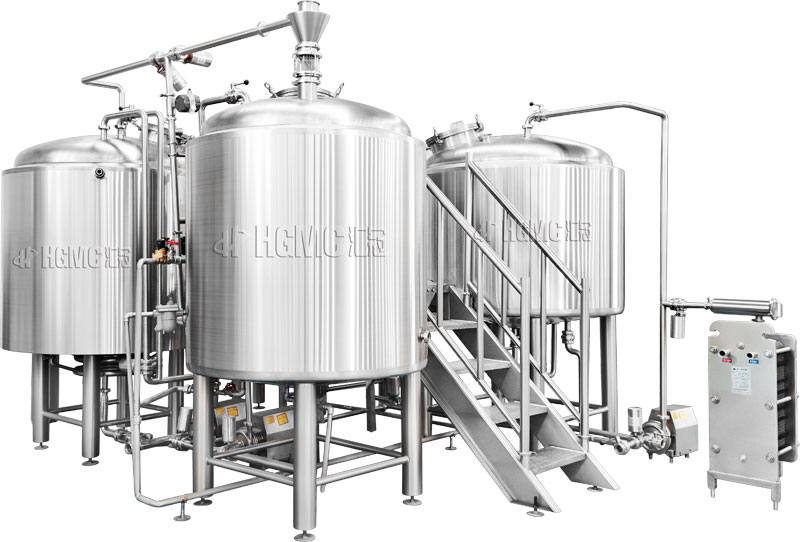
 In terms of space utilization and efficiency improvement, modular equipment has demonstrated astonishing adaptability. Its compact design typically reduces the equipment's floor space by approximately 30%. For small wineries with an average production area of only 100 square meters, this means that more than 30 square meters can be freed up for tasting rooms or storage, directly generating additional revenue. The modular piping and control system has reduced the installation and commissioning time from the traditional 4 weeks to 10 days, and increased the equipment start-up speed by 60%. More importantly, its integrated CIP (In-place Cleaning) module can reduce the cleaning time from 4 hours to 1.5 hours, saving 50% of cleaning water and 40% of steam energy consumption. According to a 2023 survey report on the craft beer industry in the Asia-Pacific region, breweries that adopt efficient modular heat exchange systems have a median energy cost per liter of beer that is 0.15 yuan lower than the industry average. With an annual production capacity of 500 kiloliters, they can save over 75,000 yuan in operating costs in a year.
Ultimately, the strategic value of modular craft beer equipment lies in its future-oriented scalability. When market demand grows at a rate of 20% annually, wineries do not need to replace the entire system. They only need to add fermentation or mashing modules at an additional cost of about 20-30% of the initial investment to increase production capacity by 50-100% within two weeks. This design has delayed the capital expenditure for capacity expansion by at least two years, significantly improving the project's financial model and risk resistance capacity. As the craft beer industry analysis agency "Brewers Journal" pointed out in 2022, modularization has become the mainstream solution for small breweries, with its market share growing at an average annual rate of 15% over the past five years. It is not merely a set of equipment, but rather a business model carrier that supports continuous innovation, flexible growth and precise resource management. It enables every winemaker with a dream to freely arrange every movement of their own flavor symphony within a controllable risk range, just like a conductor.
In terms of space utilization and efficiency improvement, modular equipment has demonstrated astonishing adaptability. Its compact design typically reduces the equipment's floor space by approximately 30%. For small wineries with an average production area of only 100 square meters, this means that more than 30 square meters can be freed up for tasting rooms or storage, directly generating additional revenue. The modular piping and control system has reduced the installation and commissioning time from the traditional 4 weeks to 10 days, and increased the equipment start-up speed by 60%. More importantly, its integrated CIP (In-place Cleaning) module can reduce the cleaning time from 4 hours to 1.5 hours, saving 50% of cleaning water and 40% of steam energy consumption. According to a 2023 survey report on the craft beer industry in the Asia-Pacific region, breweries that adopt efficient modular heat exchange systems have a median energy cost per liter of beer that is 0.15 yuan lower than the industry average. With an annual production capacity of 500 kiloliters, they can save over 75,000 yuan in operating costs in a year.
Ultimately, the strategic value of modular craft beer equipment lies in its future-oriented scalability. When market demand grows at a rate of 20% annually, wineries do not need to replace the entire system. They only need to add fermentation or mashing modules at an additional cost of about 20-30% of the initial investment to increase production capacity by 50-100% within two weeks. This design has delayed the capital expenditure for capacity expansion by at least two years, significantly improving the project's financial model and risk resistance capacity. As the craft beer industry analysis agency "Brewers Journal" pointed out in 2022, modularization has become the mainstream solution for small breweries, with its market share growing at an average annual rate of 15% over the past five years. It is not merely a set of equipment, but rather a business model carrier that supports continuous innovation, flexible growth and precise resource management. It enables every winemaker with a dream to freely arrange every movement of their own flavor symphony within a controllable risk range, just like a conductor.
Why is modular craft beer equipment ideal for small breweries?
For small craft breweries, the modular craft beer equipment is like a set of high-precision Lego bricks. It gives entrepreneurs limited initial resources to build a brewing stage that can both start steadily and grow freely. At the financial level, this modular strategy can lower the initial investment threshold from approximately 2 million yuan to 800,000 to 1.2 million yuan. By purchasing core units in phases, the winery can save about 40% of capital expenditure and use the valuable cash flow for market expansion. Data shows that small wineries that introduce modular equipment in phases have an average payback period of 18 months, which is six months shorter than a one-time investment in large fixed systems. For instance, when a distillery named "Quantum Brewing" in Hangzhou was launched in 2021, it first invested in a core 2-barrel (approximately 234 liters) modular mashing and fermentation system. After achieving a revenue of 600,000 yuan in its first year, it further invested in independent fermentation tanks and craft beer equipment. This strategy reduced its first-year loss rate by 25% and quickly turned its cash flow positive.
From the perspective of the flexibility of production and operation, the core advantage of modular design lies in its "plug and play" collaborative capability. A standard modular mashing system enables winemakers to complete the production of two batches of different formulas within 8 hours, increasing the equipment utilization rate from 65% of the traditional single system to over 85%. Each fermentation module is an independent temperature control unit that can simultaneously carry out the fermentation of ale (20°C) and Lager (10°C) within a week, increasing product diversity by 50%. The story of a small brewery in Brooklyn, USA, is highly representative. They successfully launched over 24 seasonal experimental beers within a year by using a modular system. Among them, the launch cycle of a limited edition sour beer was only three weeks. Their rapid response to market trends led to a 35% increase in sales. This agility is precisely achieved by modular craft beer equipment through standardized interfaces and automated control units. The variance of flavor indicators between batches can be controlled within 2%, ensuring stable quality at the speed of innovation.
In terms of space utilization and efficiency improvement, modular equipment has demonstrated astonishing adaptability. Its compact design typically reduces the equipment's floor space by approximately 30%. For small wineries with an average production area of only 100 square meters, this means that more than 30 square meters can be freed up for tasting rooms or storage, directly generating additional revenue. The modular piping and control system has reduced the installation and commissioning time from the traditional 4 weeks to 10 days, and increased the equipment start-up speed by 60%. More importantly, its integrated CIP (In-place Cleaning) module can reduce the cleaning time from 4 hours to 1.5 hours, saving 50% of cleaning water and 40% of steam energy consumption. According to a 2023 survey report on the craft beer industry in the Asia-Pacific region, breweries that adopt efficient modular heat exchange systems have a median energy cost per liter of beer that is 0.15 yuan lower than the industry average. With an annual production capacity of 500 kiloliters, they can save over 75,000 yuan in operating costs in a year.
Ultimately, the strategic value of modular craft beer equipment lies in its future-oriented scalability. When market demand grows at a rate of 20% annually, wineries do not need to replace the entire system. They only need to add fermentation or mashing modules at an additional cost of about 20-30% of the initial investment to increase production capacity by 50-100% within two weeks. This design has delayed the capital expenditure for capacity expansion by at least two years, significantly improving the project's financial model and risk resistance capacity. As the craft beer industry analysis agency "Brewers Journal" pointed out in 2022, modularization has become the mainstream solution for small breweries, with its market share growing at an average annual rate of 15% over the past five years. It is not merely a set of equipment, but rather a business model carrier that supports continuous innovation, flexible growth and precise resource management. It enables every winemaker with a dream to freely arrange every movement of their own flavor symphony within a controllable risk range, just like a conductor.
In terms of space utilization and efficiency improvement, modular equipment has demonstrated astonishing adaptability. Its compact design typically reduces the equipment's floor space by approximately 30%. For small wineries with an average production area of only 100 square meters, this means that more than 30 square meters can be freed up for tasting rooms or storage, directly generating additional revenue. The modular piping and control system has reduced the installation and commissioning time from the traditional 4 weeks to 10 days, and increased the equipment start-up speed by 60%. More importantly, its integrated CIP (In-place Cleaning) module can reduce the cleaning time from 4 hours to 1.5 hours, saving 50% of cleaning water and 40% of steam energy consumption. According to a 2023 survey report on the craft beer industry in the Asia-Pacific region, breweries that adopt efficient modular heat exchange systems have a median energy cost per liter of beer that is 0.15 yuan lower than the industry average. With an annual production capacity of 500 kiloliters, they can save over 75,000 yuan in operating costs in a year.
Ultimately, the strategic value of modular craft beer equipment lies in its future-oriented scalability. When market demand grows at a rate of 20% annually, wineries do not need to replace the entire system. They only need to add fermentation or mashing modules at an additional cost of about 20-30% of the initial investment to increase production capacity by 50-100% within two weeks. This design has delayed the capital expenditure for capacity expansion by at least two years, significantly improving the project's financial model and risk resistance capacity. As the craft beer industry analysis agency "Brewers Journal" pointed out in 2022, modularization has become the mainstream solution for small breweries, with its market share growing at an average annual rate of 15% over the past five years. It is not merely a set of equipment, but rather a business model carrier that supports continuous innovation, flexible growth and precise resource management. It enables every winemaker with a dream to freely arrange every movement of their own flavor symphony within a controllable risk range, just like a conductor.
Assaggia il nostro Parmigiano Reggiano DOP
Dal caseificio di Vetto alla tua tavola, con spedizione refrigerata in 34 Paesi.